
Mortgage Rates Near 7% Are Freezing Buyers. Here’s What It Means if You Need to Sell in Austin
Updated November 2026 · Fast Cash Home Buyers · Austin, Leander, Cedar Park, Round Rock & Georgetown
A year ago, a buyer shopping for a home in Round Rock or Cedar Park could lock a 30-year mortgage at a little over 6%. Today that same buyer is staring at a rate above 7%, a monthly payment that has jumped by double digits, and a lender asking for more paperwork than ever. Many of them have simply stopped shopping.
If you need to sell your house in the next few months, that matters more than any headline about home prices. Fewer buyers who can qualify means fewer offers, longer waits, and more deals that fall apart before closing. Here’s what the latest data shows and what you can do about it.
7.24%
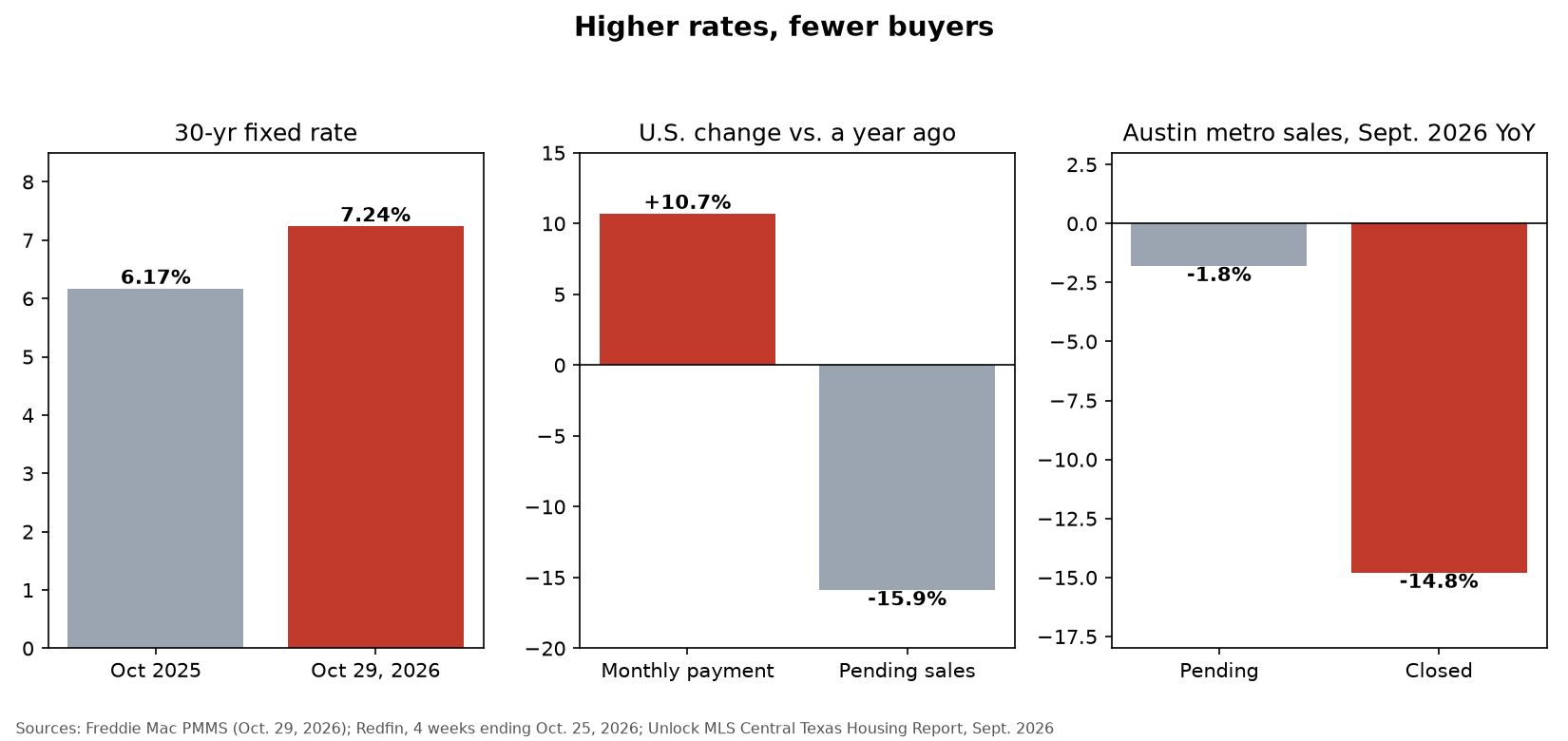
30-year fixed mortgage rate, Oct. 29, 2026 — up from 6.17% a year earlier (Freddie Mac)
+10.7%
Rise in the typical U.S. buyer's monthly payment year over year, to $2,786 (Redfin)
−15.9%
Drop in U.S. pending home sales year over year — lowest level since 2021 (Redfin)
−14.8%
Austin metro closed sales year over year, September 2026 (Unlock MLS)
Rates Jumped More Than a Full Point in a Year
Freddie Mac’s weekly survey put the average 30-year fixed mortgage rate at 7.24% on October 29, 2026, down slightly from 7.32% the week before but well above the 6.17% of a year earlier. The 15-year fixed averaged 6.60%, compared with 5.41% a year ago (Freddie Mac PMMS).
A one-point jump sounds small. On a typical loan it isn’t. Redfin estimates the median U.S. homebuyer’s monthly mortgage payment hit $2,786 in the four weeks ending October 25, up 10.7% from a year earlier and the second-highest level on record. That’s with home prices basically flat. Almost all of the increase is the cost of borrowing.
🏦 Key data point
The typical U.S. buyer’s monthly payment is up 10.7% in a year, to $2,786, even though the median sale price barely moved.
For a buyer, that means qualifying for less house, or deciding to keep renting and wait. For a seller, it means the pool of people who can actually close on your home just got smaller.
Buyers Are Pulling Back Across the Country
The clearest sign is in pending sales — the homes that go under contract each month. Redfin counted 276,352 pending sales nationally in the four weeks ending October 25, down 15.9% year over year and the lowest level in its records going back to 2021. Pending sales fell in all 50 of the largest U.S. metros, and that was the case for three weeks in a row (Redfin).
That’s not one weak market. It’s buyers everywhere pressing pause at the same time.
What It Looks Like in Central Texas
Locally, the freeze is showing up in closed sales more than in new contracts. Unlock MLS reported that pending sales across the Austin-Round Rock-San Marcos metro dipped 1.8% in September to 2,313, while closed sales fell 14.8% to 2,223.
That gap is worth paying attention to. Contracts are still being signed, but fewer of them are turning into finished sales. Some of that is timing. Some of it is the reality of financed deals in a high-rate market: the buyer’s rate lock expires, the appraisal comes in low, the debt-to-income ratio no longer works, or the buyer gets cold feet when they see their final payment.
📉 Key data point
Austin-area pending sales slipped 1.8% in September 2026, but closed sales dropped 14.8%.
Meanwhile, sellers are adjusting. Nationally, 21.5% of homes for sale had a price drop in the latest Redfin data, and the typical home sold for 98.3% of its list price. In the Austin metro, Unlock MLS reported homes closed at 92.7% of their original list price in September. Lower prices help buyers a little, but at 7% rates they don’t fully offset the higher payment.
The Hidden Risk: Financing Falls Through
When rates are low and buyers are plentiful, a failed loan is an annoyance. You put the house back on the market and take the next offer. When buyers are scarce, a deal that collapses three weeks into escrow can cost you a month or two of extra mortgage payments, taxes, insurance and utilities, plus the stigma of a listing that “came back on the market.”
Every financed sale has to clear several hurdles that have nothing to do with you or your house:
- Loan approval. Higher payments push more buyers past lender debt-to-income limits.
- Appraisal. If prices are flat or slipping, the appraisal may come in below the contract price, and someone has to make up the gap.
- Rate lock timing. Delays can push a buyer past their locked rate, and a new rate can change whether they qualify.
- Lender-required repairs. FHA and VA loans in particular can require fixes before closing.
If your home needs repairs, has a title issue, or you’re on a deadline, each of those hurdles is a place where the sale can stall. Read more on how rising interest rates affect sellers in Austin.
Why Cash Skips the Rate Problem
A cash buyer isn’t affected by the mortgage rate. There’s no lender, no loan approval, no appraisal contingency, and no rate lock to expire. That’s the main reason cash sales can close in days or a few weeks instead of waiting on a lender’s timeline, and that comes after the weeks or months it takes to find the buyer.
A cash sale also lets you sell as-is. You don’t need to fix the roof or update the kitchen to satisfy an appraiser or an FHA inspector. You pick the closing date, which matters if you’re relocating, going through a divorce, or trying to get ahead of missed payments.
The trade-off is real: a cash offer is usually below what a fully updated home might list for in a strong market. But this isn’t a strong market for sellers who need financed buyers. The fair comparison is the cash offer against what you’d actually net from a traditional sale after price cuts, commissions, repairs, months of holding costs, and the risk that a buyer’s loan falls through. Compare the options in our guide to cash buyers vs. realtors in Austin.
💡 Seller tip
If you list traditionally, ask your agent how many recent contracts in your neighbourhood fell through, and require proof of a full loan pre-approval — not just a pre-qualification — before you accept an offer.
Should You Wait for Rates to Drop?
Maybe. Nobody can promise where rates will be next spring. Freddie Mac’s survey ticked down in the latest week, but rates are still more than a point above last year. Waiting has its own cost. Every month you hold the house, you keep paying the mortgage, property taxes, insurance and upkeep. If the house is vacant, you’re paying all of that with no rental income to offset it.
If rates do fall, more buyers will come back — but so will more competing listings. Sellers who waited will all list at once, and the advantage of a less crowded market disappears. Read our full breakdown of the true cost of waiting to sell.
If you have a specific reason to sell now — a job move, a divorce, an inherited property, financial pressure, or a home that needs more work than you want to take on — waiting for a better rate environment may cost more than it saves.
Key Takeaways
- ✓The 30-year mortgage rate hit 7.24% in late October 2026, up from 6.17% a year ago (Freddie Mac).
- ✓The typical U.S. buyer’s monthly payment rose 10.7% year over year to $2,786, pushing many buyers out of the market (Redfin).
- ✓U.S. pending sales fell 15.9% year over year — the lowest level since 2021 (Redfin).
- ✓Austin-area closed sales fell 14.8% in September while pending sales dipped 1.8% (Unlock MLS), a sign fewer contracts are making it to closing.
- ✓Financed deals face loan, appraisal and rate-lock risks. Cash sales avoid all three.
- ✓If you’re on a deadline or your home needs work, compare a cash offer to your realistic net from a traditional listing.
Need to Sell Without Waiting on a Lender?
Fast Cash Home Buyers buys houses for cash across Austin, Leander, Cedar Park, Round Rock and Georgetown. We buy as-is, cover typical closing costs, and close on your timeline. There’s no obligation to accept our offer.
Get your free cash offer →Sources: Freddie Mac Primary Mortgage Market Survey (Oct. 29, 2026); Redfin housing market press release (Oct. 29, 2026); Unlock MLS Central Texas Housing Report (Sept. 2026).